
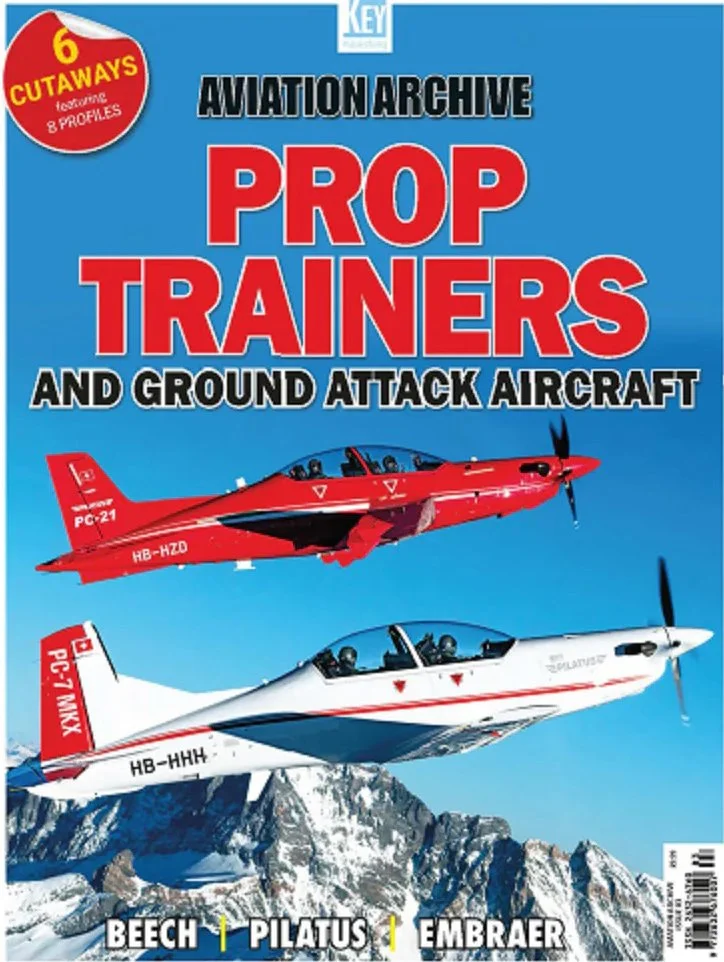
Prop Trainers and Ground Attack Aircraft Since 1945
Every fighter, bomber, transport and helicopter pilot has had to learn to fly something simpler, and since World War Two that has usually been a two-seat light aircraft powered by a single piston engine or turboprop. The humble ‘pilot makers’ have taken tens of thousands of men and women on their first steps into military aviation careers.
Trainers have also been adapted to more aggressive roles. From the NAA AT-6 Texan to the Pilatus PC-9, repurposed trainers have seen action in the counterinsurgency role and for air policing and other tasks where a jet fighter is not available, not suitable or not necessary. The type with the most aerial kills in modern military service might be the Embraer Super Tucano, used against drug smuggling planes. Today, in the Russia-Ukraine War, back seaters in piston-engined Yak-52s are shooting down explosive-laden UAVs with light machine guns.
Turbine engines have helped trainers approach the performance and handling of light jets, in some cases eliminating them from the training pipeline altogether. These days a trainee might graduate from a Texan II straight into a Typhoon or tanker.
The Aviation Archive series presents the wide range of post-war training and ground attack aircraft using detailed cutaway drawings and colourful profile illustrations as well as archive and contemporary photographs.